It's been a long time. Hisashiburi desu ne! Well, I am still studying Japanese, though not as often as I used to. It has become a bit easier with the advent of chatbots and with all the helpful videos on Facebook and elsewhere. In the mean time, I've also been learning Chinese, and I'm finding a lot of overlaps. Still a long way to go. But I was happy to find that this blog is still here. Some great memories in those photos. I'll return here from time to time with more recent updates. I haven't been to Shikoku since I came back home, but I am planning another trip next year.
2025/06/26
2013/08/05
Back in America
I've been back in America since 2011. Long story short, I look forward to visiting Japan again. I'll still write a post here and there, when I find out something interesting. If you're interested in the previous years, you can see part of what I learned and wondered about while I was living in Japan.
2009/02/02
Okinawa: Bus from Naha (Bus Route Numbers)
GOING TO
Chatan (Sunset beach, American Village, Mihama area): 20, 28, 29
Yomitan (Zanpa Cape, Nikko Alivilla Hotel, Yachimun Pottery Town area): 28, 29
Onna village (Manza-mo, Manza Beach Hotel area): 20, 120
Nago city (Orion Beer brewery, Busena Terrace Hotel, Churaumi Aquarium): 20, 120
--to get to Churaumi Aquarium, you must change busses at Nago Bus Terminal.
Churaumi Aquarium from Nago Bus Terminal, take bus # 65 or 70.
[Get a time table at the terminal. Also for your return trip.]
Yes, you can. :)
DETAILED INFORMATION
How to get on buses
<http://www.okinawa.usmc.mil/public%20affairs%20info/Archive%20News%20Pages/2006/061215-bus.html>
Bus Maps
North area = Northern than Kyoda(許田)<http://www.rosenbus.com/TimeTBL/RoadMap/HOKUBU.jpg
>
Middle area=From Naha to Onna Village<http://www.rosenbus.com/TimeTBL/RoadMap/CYUBU.jpg>
Southern Area=Naha and Southern than Naha city<http://www.rosenbus.com/TimeTBL/RoadMap/NANBU.jpg>
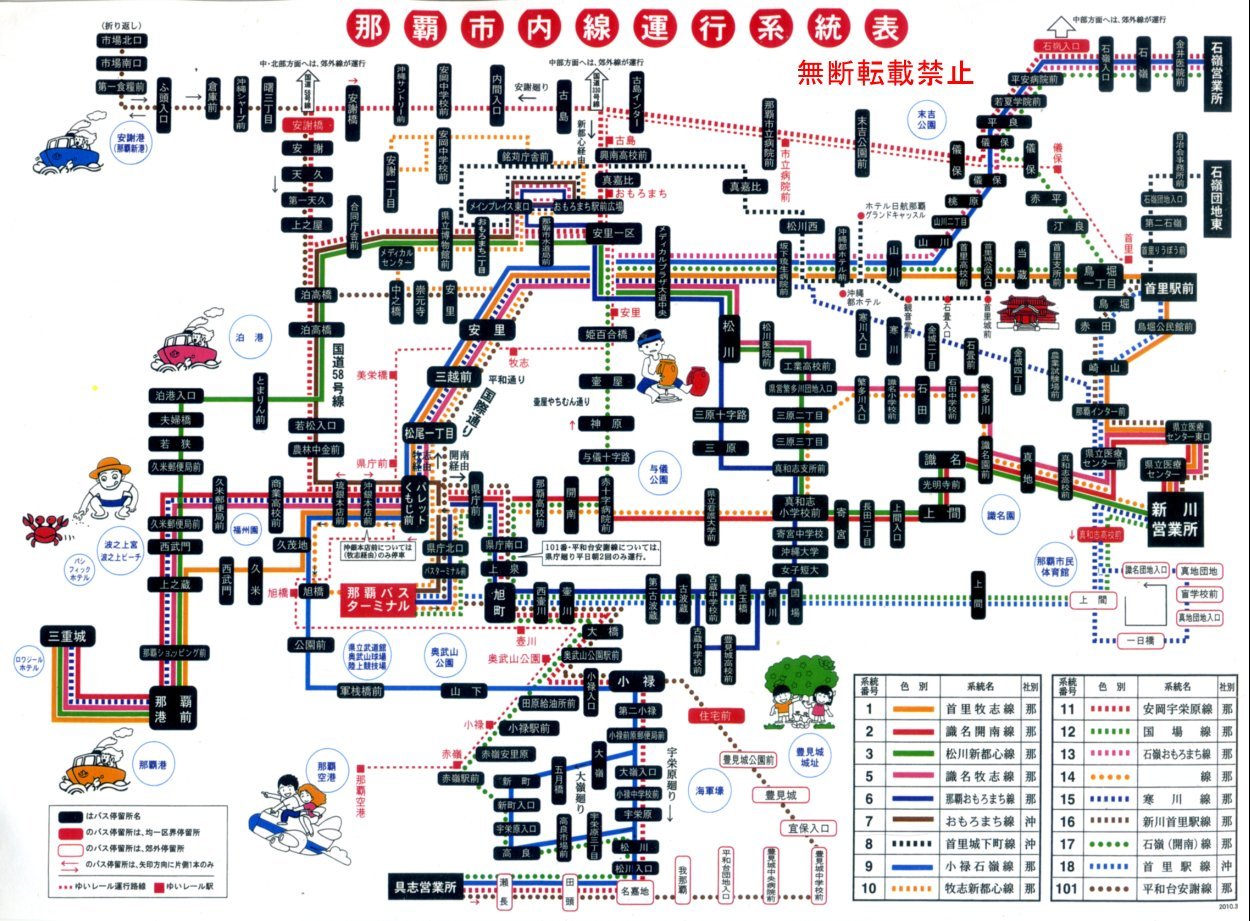
Inside Naha City<http://www.rosenbus.com/TimeTBL/RoadMap/NAHA.jpg>
These maps are all in Japanese.
A FEW TIPS
1. You raise your hand when you want to get on.
2. Though there are four different bus companies running, they all use the same numbers for the same routs, so you just have to pay attention to the #s. When you get on a bus in Naha city, the buses that have # between 1 and 19 (except for 15) only run inner City. Buses that have # 15 and 20 or bgger number run outside of the city.
3.If you wanna site see inner Naha city like Kokusai St. and Shuri castle, and beaches, you can purchase a one-day pass. It costs about as much as you pay for one time.
2009/01/24
Moving to Uwajima
Hi, it's been a while since I posted a blog entry. I'll be moving to Uwajima on March 1st, 2009. Between February 20th and 27th, I'll take a break in Okinawa. I'm just now planning the Okinawa trip and will have lots of photos and stories from that! I found a kind of domestic shipping service that will transport my few suitcases and boxes to the new address, so I can just get on the plane and enjoy the vacation. For anyone moving in Japan, you might find it useful also. More to come.
2008/05/03
2008/05/02


2008/04/29
A Rainbow at the River's Edge
風薫る
色とりどりの
鯉が舞い
Cool light summer breeze
All the season's colors flow;
The river dances
2008/04/28
My Life, in Transit
Train from Shikoku to Okayama
Trees rush past windows;
Olden houses stand sadly;
My life, in transit.
(Okayama. April, 2008)
A Fish In And Out Of Water
 灰色の鶴、
灰色の鶴、
羽を広げる、
心地よく。
Gray crane spreads his wings;
Children laugh and feed the fish;
I now feel at home.
(Sanuki. April, 2008)
2008/04/27
Tomo ni Naru (友になる)
 春の公園
春の公園
お抹茶を飲んで
友になる
Spring at Ritsurin.
Shall we have some tea, she glanced,
And we became friends.
(Sanuki. April, 2008)
The tea house at Ritsurin Park
Flowers in Sanuki
 Nihon de ha
Boku no itoshiki
Sakura kana
(Sanuki. April, 2008)
Today was a day of flowers. I went to Ritsurin Park and had matcha (green tea) in a traditional tea house. In keeping with tradition, the people seated next to me spoke amiably and we exchanged contact information. I hope that we can become friends. I then went to Jardin (from the French, "garden") to see floral designs. I have posted some of my photographs from Jardin. I went with a close friend who invited me to her house, and I was able to meet and talk with her mother, who is a calligrapher. She brushed the calligraphy above, based on a haiku we wrote together. I felt very warm and welcome. What a wonderful way to start Golden Week.


2008/04/24
Poll (投票)
What would you like to see on this blog? Please comment. English and Japanese are both OK.
ブログでどんなものを読みたいですか?英語でも日本語でもOKですので、コメントください
2008/04/20
Naoshima (Art Island) 2
 I took a ferry from Sunport Takamatsu to Naoshima (Art Island) today. It is far and above one of the best experiences I have had in Japan so far. The island is awash with museums, galleries, architecture, and culture. Let me share some of my photographs, videos, and experiences with you. I arrived at the ferry from Takamatsu at 9:45 in the morning, and the boat is pictured on the left. The ride was a pleasure. It takes about one hour and you can sit on the upper deck and watch as the boat passes many beautiful islands on the way to Naoshima.
  On arrival, I took this bus (left) to Chichu Art Museum. But before boarding the bus, don't forget to go into the station and pick up the bus schedule as well as maps of the island and an English guide if you need one. The bus costs only 100 yen ($1) for each ride. It is possible to walk or bicycle to the various desinations, but the bus is simply more convenient. You'll want to maximize your time looking at the art! Inside Chichu Art Museum you'll find dreamlike rooms by Walter de Maria (Time / Timeless / No Time); fantastical spaces by James Turrell (particularly Open Field). Open Field starts as a blue square on the wall, rather uncompelling. Until you realize that you can walk up a set of stairs, and it is not a blue square, but rather an entrance that you can walk into (!) only to discover that you have entered a minimalist painting. I'm not kidding. It is one of the most psychedelic works of art I have ever experienced. Once inside the painting, turn around for a surprise about the entrace in to which you walked. There are also four works by Claude Monet. The building is a masterwork by Tadao Ando, itself pure art. Photographs are strictly forbidden, hence no images. But you really need to experience these works with your own eyes and body in order to appreciate them anyway.
 Among myriad smaller galleries, this one features ink paintings. They use classical techniques to express modern images of sakura blossoms and coastal scenes. There is also the Art House Project, comprising six buildings. It costs 1,000 yen ($10) for access to all six buildings. One in particular, again by Tadao Ando, starts with pitch darkness so disorienting that it is nearly intoxicating. But as you sit in the dark for about five minutes, your eyes adjust and you can see lights in the distance. You then stand and walk toward the light, putting you hand into it, with surprising effects.
  Fish flags wave outside of a traditional-style building. In addition to all of this architecture, Naoshima also features beautiful beaches with pristine, clear water. Birds call from overhead and the wind gently blows as you immerse yourself in nature and art. As you continue to walk the island, your mind reels with what you have already seen, and with the anticipation of what is to come. It is a place for discovery, for intrigue, and for life experience. No matter what your views on art, it's worth the trip.
See if you can spot these cute metallic signs.

The new meets the old as a digital mosaic flashes inside a traditional building.
 Stone etchings near a shrine with a sacred staircase made of ice that will not melt under the blazing sun and descends into infinity for your viewing pleasure.
 Light streaming into a narrow stone passage.
Wind moves metal at the beaches of Naoshima.
2008/04/14
Shikoku Mura (Shikoku Village)
 I visited Shikoku Mura (Shikoku Village), which is an open-air, walk-through museum of sorts. It is a preservation of traditional Japan and Shikoku. It for me brought up the feeling of the Japan I had always seen in films. Its attractions include a bine bridge; Shodoshima Farmers Kabuki Theater; Yamashita family house; Kohno family house; Sugar cane press; Shikoku-mura Gallery; Nanyo tea hall; Bamboo grove; Lighthouse from Okunoshima; Light house from Cape Esaki (and others); Bark-steaming hut; Shimoki family house; Water-powered rice mill; more family residences; an arched bridge; an old fire station; a soy sauce malthouse; and other similarly folksy attractions. This face of Japan is somewhat lost in the city, although elements remain throughout Japan. And, this is preserved. It's not far, and you can get there by public transportation. Here are some of my photographs from my first visit.

Cross this bridge, suspended by vines, to enter
 A Kabuki theater that still hosts performances

An old-fashioned residence

Inside the residence

A sugar mill with sakura

Inside the sugar mill
 Walkway into the bamboo grove

Water glide outside a small art gallery
2008/04/06
O-Hanami in Takamatsu
 There was a huge o-hanami (flower viewing) party at Ritsurin Park yesterday. It was great to sit under the trees with friends and chat all day, with blazing sunlight and beautiful nature all around. In America, there is a similar party in Washington DC, but it is not quite the same as in Japan. The American version is a bit toned down, and it is often cold at that time. The Japanese version is extremely festive and warm, and it is steeped in centuries-old tradition. If you find yourself in the Takamatsu area, definitely check out Ritusrin Park.
How Many Roads?
At Ritsurin Park, Takamatsu. O-hanami (flower viewing) party.
A group from the Philippines had come and played music.
2008/03/30
Cherry Blossoms in Takamatsu
 Today I went to Ritsurin Park to see cherry blossoms. Even though it was raining, it was a wonderful time. The park is so beautiful. It's the kind of place you'd want to walk around, even if you have to put your umbrella up. There are winding paths, ducking in and out of wooded areas, as well as bridges arching over ponds with fish swimming in them. One of the reasons I came to Takamatsu was to experience the natural beauty of Japan, rather than it's intense urban centers, and I am finding just that.
 My father sometimes describes these type of images as emblematic of the beginning of time. I know the feeling. When I look at these stalks in the water, I can imagine what ancient poets might have been thinking when they wrote. It was very peaceful and calm. I am going to go again next weekend, with a totally different atmosphere. It will be daytime, and I expect not a rainy day. The next time, there will be a group of about 20 people, and we'll all bring a lunch box and plenty to drink. That's the tradition, so we can all live it up and have a great time together. Ritsurin park is actually really close to my apartment, so I can go there any time. It's just $4 (400 yen) to enter, which in my view is completely worth it. If you're planning to visit Shikoku, definitely don't miss it.
 Lastly, my friend and I went to Youme Town, which is a kind of shopping mall with a little bit of everything. There is a grocery store which includes foreign foods and even organic ones, which I didn't know was popular in Japan. There is also a pet store, where I saw the cutest animals. It's definitely worth a trip to Youme Town if you're in Takamatsu and are craving something other than udon shops for a change. You can get Chinese and Korean food as well.
Subscribe to:
Posts (Atom)